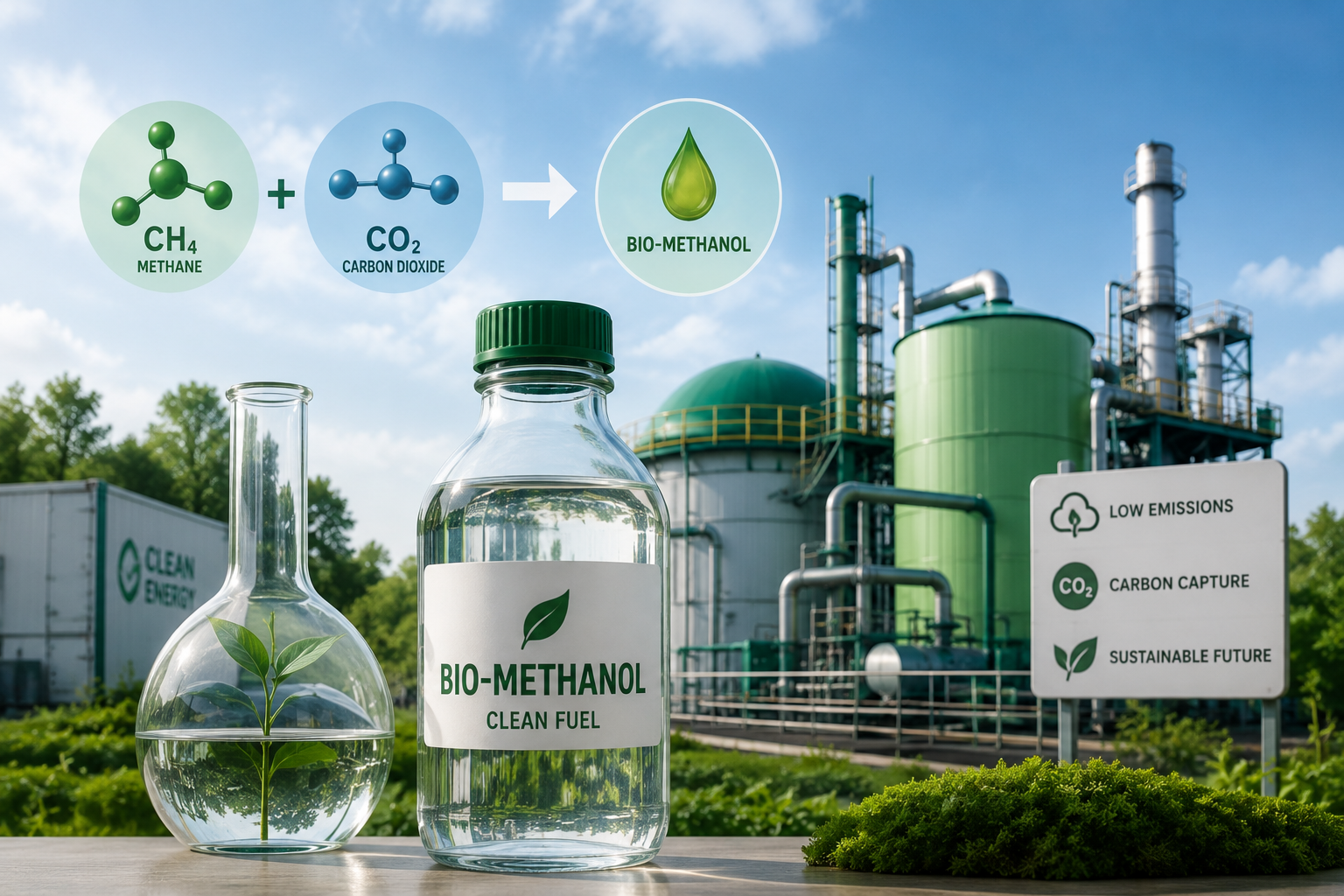
A technology that can consume two of the world's most potent greenhouse gases — methane and carbon dioxide — and turn them into a clean, high-performing fuel has just taken a decisive step from the laboratory toward the market. On 28 May 2026, IIT Guwahati signed a Memorandum of Understanding with Kaashyap Cleantech Innovations Private Limited for the large-scale commercialisation of its biological bio-methanol technology.
What the MoU covers
The agreement paves the way for taking IIT Guwahati's biological green methanol process from research volumes to full industrial deployment. The commercialisation effort follows encouragement from the Indian Sugar and Bio-Energy Manufacturers' Association (ISMA) and the Government of India's Department of Food and Public Distribution, both of which pushed for the establishment of a pilot plant. The partnership was reported by ET EnergyWorld and covered in the IIT Guwahati newsletter.
The science: a two-stage biological process
The breakthrough was developed by Prof. Debasish Das and PhD scholar Krishna Kalyani Sahoo of the Department of Biosciences and Bioengineering at IIT Guwahati. It uses a two-stage biological process in which chemoautotrophic bacteria act as a biocatalyst, converting methane and carbon dioxide into bio-methanol under mild conditions and without chemical catalysts.
Unlike conventional biofuels that rely on agricultural feedstocks and can compete with food resources, this process consumes greenhouse gases as its primary input. Because it actively sequesters carbon dioxide during production, the technology is positioned to qualify for carbon-credit schemes and is compatible with the Carbon Capture, Utilisation and Storage (CCUS) framework.
A look at the biological green methanol technology being commercialised by Kaashyap CleanTech Innovations.
Tested in real engines — up to 87% lower emissions
The bio-methanol was tested as a blended fuel in a four-stroke diesel engine. The results were striking: engine emissions — including carbon monoxide, hydrocarbons, hydrogen sulphide and smoke — were cut by up to 87% compared with standard diesel. The blend also outperformed pure diesel on fuel consumption and energy efficiency, while maintaining comparable mechanical efficiency.
Key takeaways
- IIT Guwahati and Kaashyap Cleantech signed an MoU on 28 May 2026 to commercialise biological bio-methanol.
- Chemoautotrophic bacteria convert methane and CO₂ into fuel under mild conditions, without chemical catalysts.
- Engine testing showed up to 87% lower emissions versus standard diesel.
- The process sequesters CO₂, making it eligible for carbon credits and aligned with CCUS.
- Indigenous production can cut India's dependence on imported methanol.
Why it matters for industry and India
Beyond transport fuel, bio-methanol is a precursor for high-value industrial chemicals such as formaldehyde and acetic acid. It also offers a practical decarbonisation pathway for hard-to-abate sectors — steel, cement and ethanol manufacturing — by converting their waste greenhouse gases into usable fuel.
There is a strategic dimension too. India currently imports a large share of its methanol. As IIT Guwahati Director Prof. Devendra Jalihal noted, the technology is ready for large-scale deployment and tackles two sustainability challenges at once: sequestering greenhouse gases and producing renewable energy. This indigenous, patented process is an opportunity to build domestic clean-fuel capacity while reducing import dependence.
"Because the process generates green fuel while simultaneously capturing carbon dioxide, it is a valuable tool for meeting global net-zero goals." — Kiran KK, Managing Director, Kaashyap Group
From research to commercial scale
Turning a laboratory process into commercial volumes is exactly what Kaashyap CleanTech Innovations exists to do. Our own biological green methanol technology — developed with IIT Hyderabad and already at TRL 9 across multiple full-scale plants — utilises in-house fermenter CO₂ and raw biogas from integrated sugar and ethanol complexes. Together, these efforts point to a future where clean methanol powers land, sea and air transport.